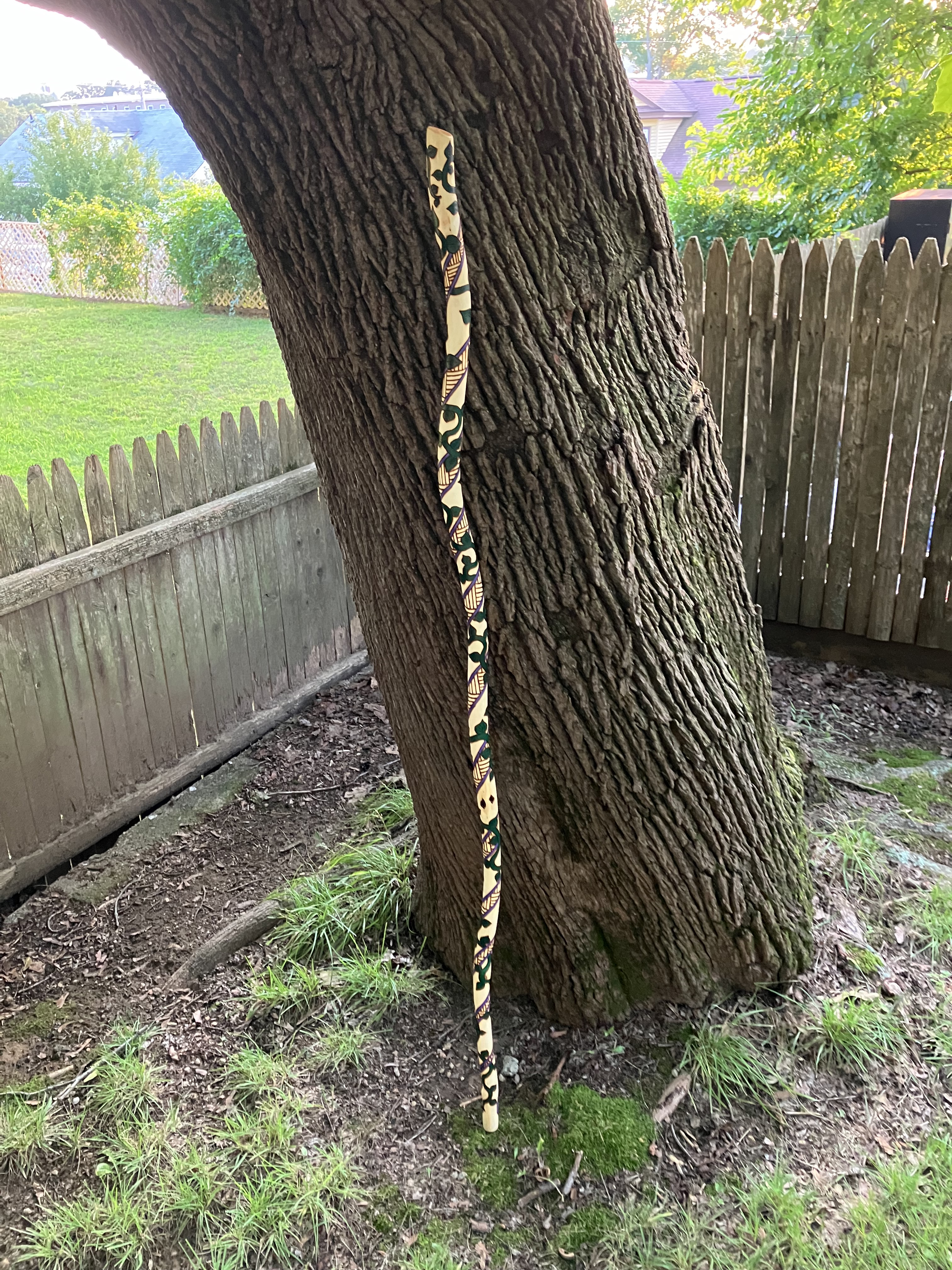
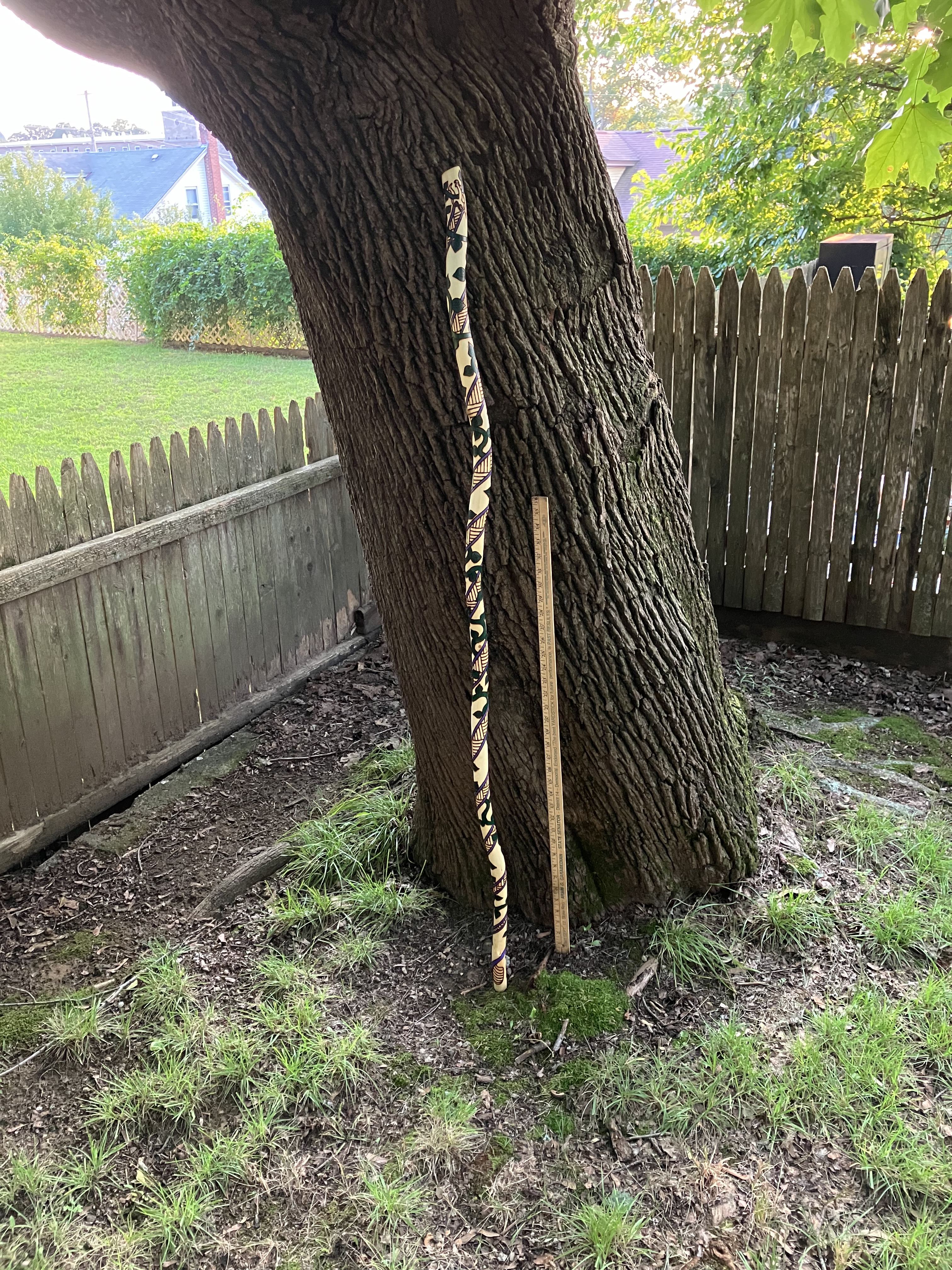
I had a lot of fun creating this piece. It combines two motifs I’ve very much enjoyed doing in the past, namely the Viking Serpent and vines, both coiling around the length of the staff. Serpents are found in mythologies from around the world and often symbolized rebirth, renewal, and knowledge, whereas vines represent a return to nature. The natural winding curvature of the wood itself enhances the overall design. It’s made of sumac wood, stands at 57.5 inches, and has multiple coats of sealant and boiled linseed oil.
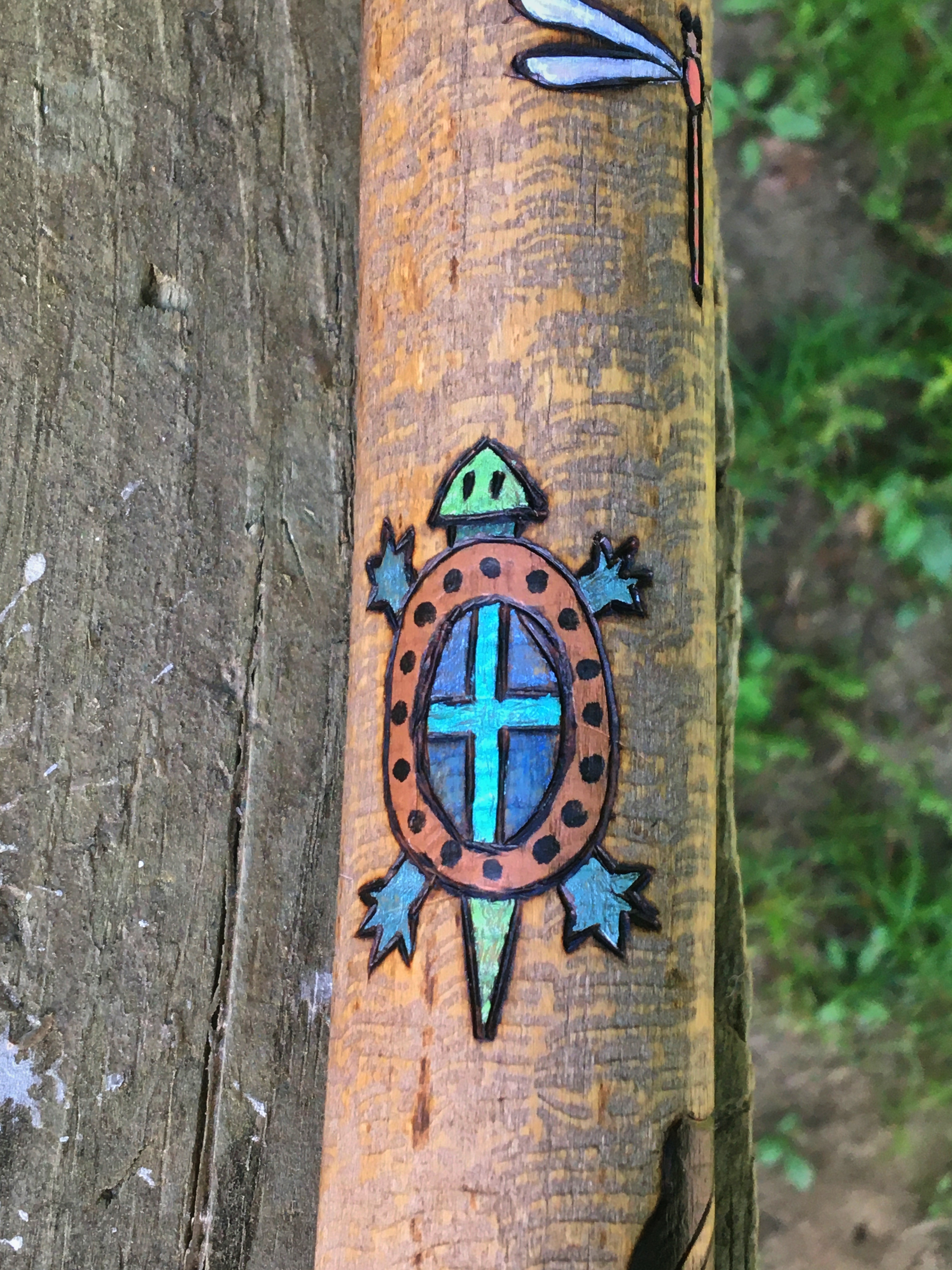
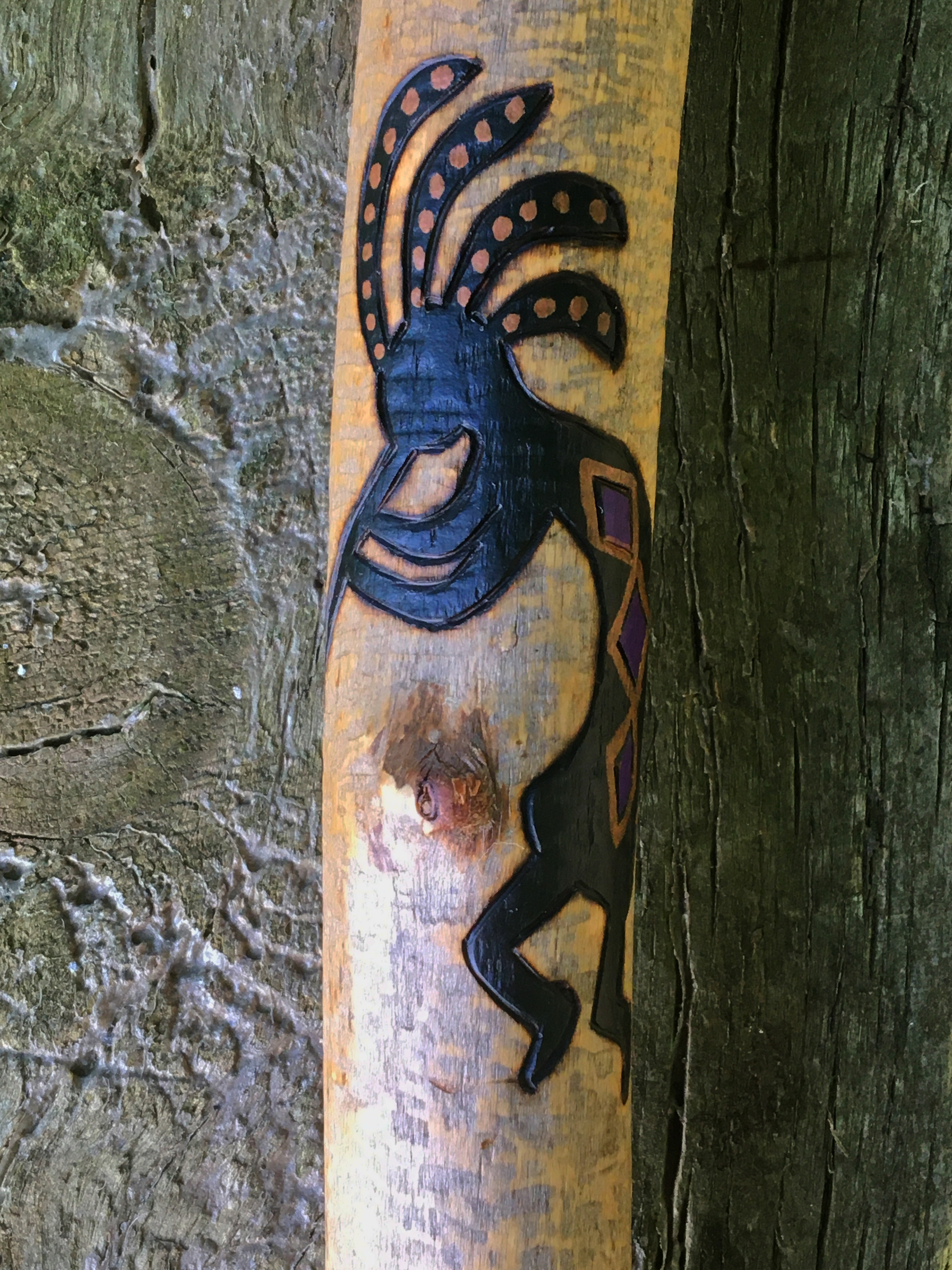
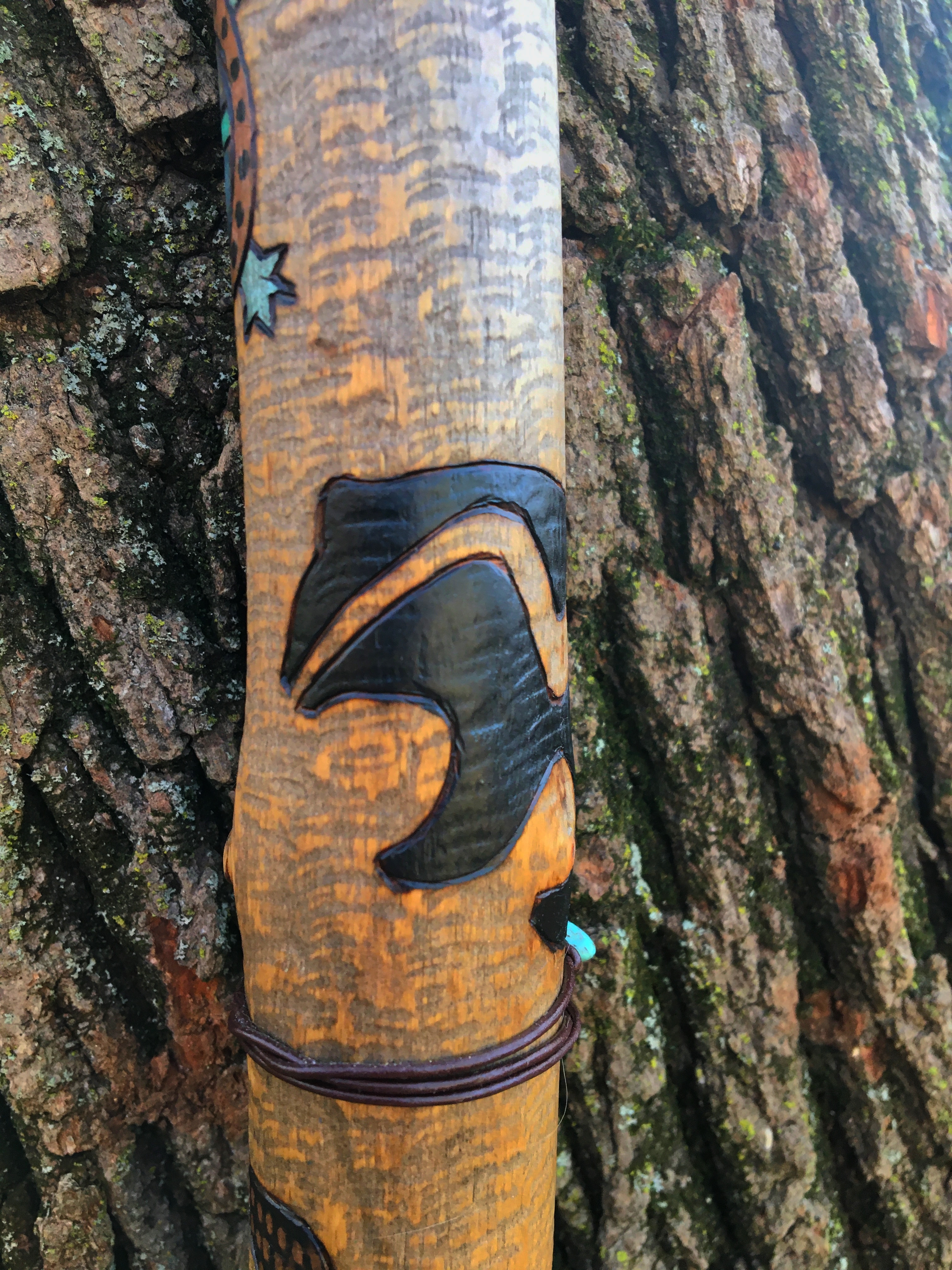
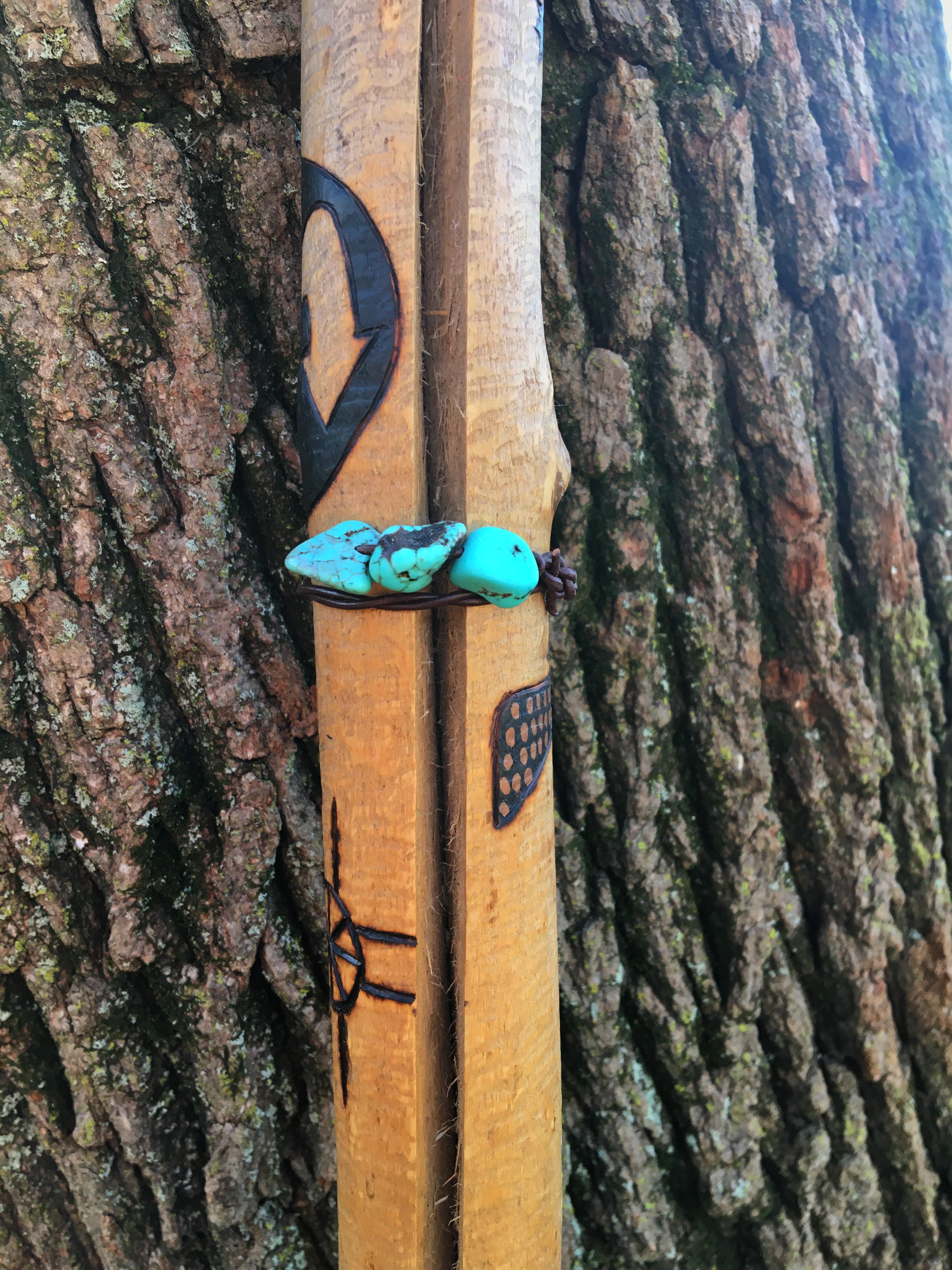
This is a shorter staff measuring only 49.5″ and is also another customized gift. It is a piece of beaver wood found in the Ammonoosuc river in New Hampshire. Both the top and bottom have been pointed by beavers and teeth marks are visible along the length of the staff. There are numerous Native American symbols depicted with wood burning, metallic pens, and paint pens. I hope it’s not a grievous case of cultural appropriation, I simply enjoy working with these symbols. Three turquoise beds are tied near the top of the staff. I used acrylic sealer and boiled linseed oil to protect the ink and wood respectively.
Many of the symbols have different stylizations and meanings depending on which tribe they’re from. I did my best to match each one with their respective tribes but couldn’t always find their specific origin. The dragonfly and butterfly depictions I used are not the same stylizations specific to any particular tribe, but the insects themselves are symbolic to many. And since meanings and styles differ greatly from tribe to tribe and clan to clan if I’ve written anything inaccurate I would like to know the accurate information.
Symbols and meanings present on staff:
Sun symbol, unspecified tribe: happiness
Dragonfly, Zuni: messengers of the spirit world, swiftness, activity
Turtle, Hopi, Navajo: persistence, longevity, mother Earth and in some myths saved their tribes from the Great Flood
Cut circle with eight projecting lines, unspecified tribe: Earth forces, permanent home
Kokopelli, Hopi, Zuni, fertility, spiritual and physical healing, love, and music
Thunderbird, found across North American tribes: most commonly associated with divine dominion, unlimited happiness, strength, protection, and indomitable spirit
Serpent Mound, Adena, Fort Ancient, or possibly earlier tribes, believed to mark solstices and special astronomical dates, spiritual power, and rebirth. It’s also similar to the Hopi Tokchi’i symbol which may represent the Serpent Mound, the guardian of the East which they believe was constructed by their ancestors
Crescent moon, unspecified tribe: guardian of Earth associated with femininity and grandmothers
Four pointed star, or Kachina, Pueblo Tribes: morning star, courage, and purity of spirit
Spiral, Pueblo Tribes: most commonly associated with a journey
Bear with arrow, Zuni: the arrow is called a heartline and traces the path of breath to the place of the spirit, represents and encourages strength and good health
Bear prints, unspecified tribe: good omen
Turquoise, Zuni: sky stone
Turquoise, modern generalized (likely from a distillation of ancient sources): wisdom, tranquility, protection, good fortune, and hope
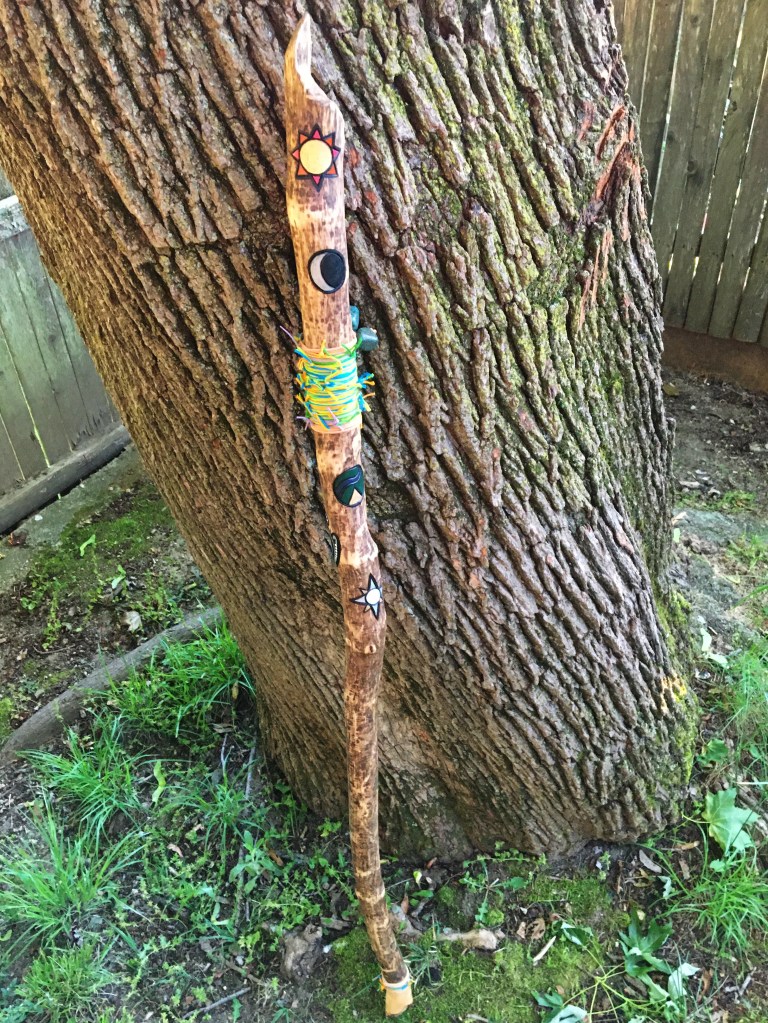
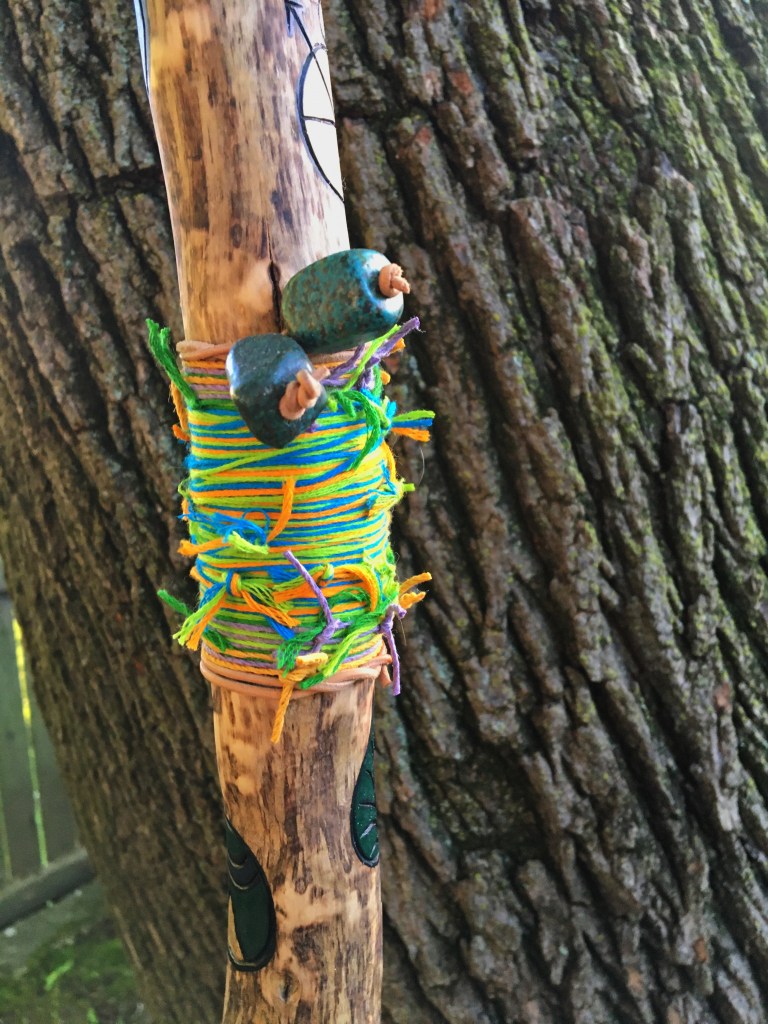
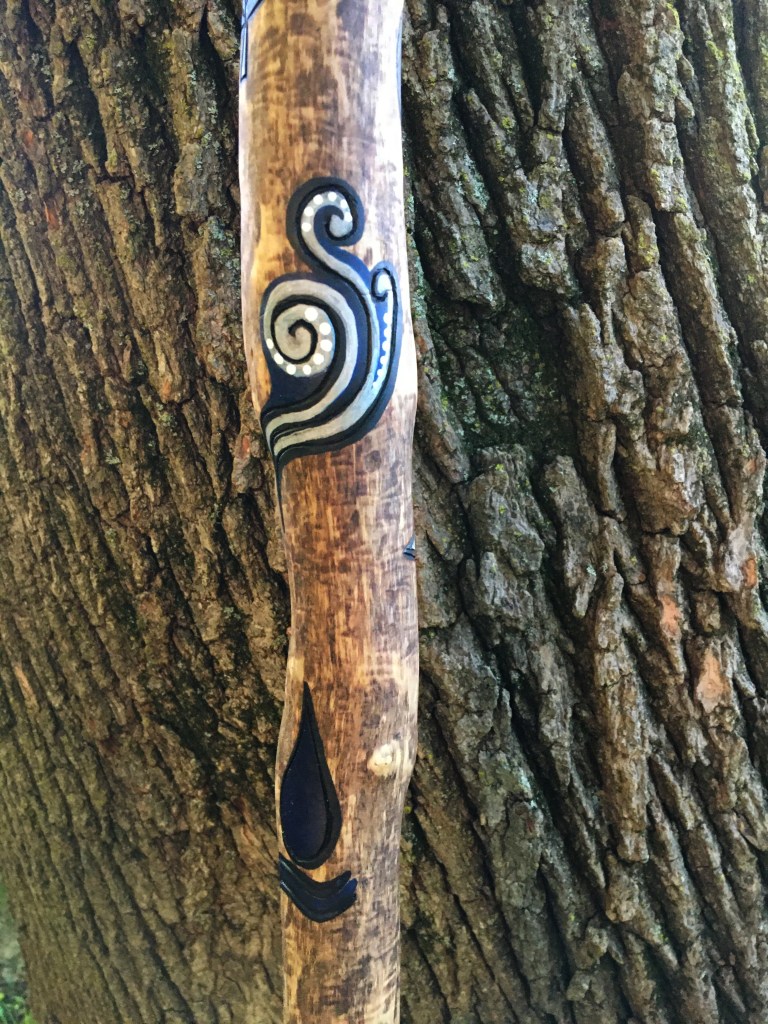
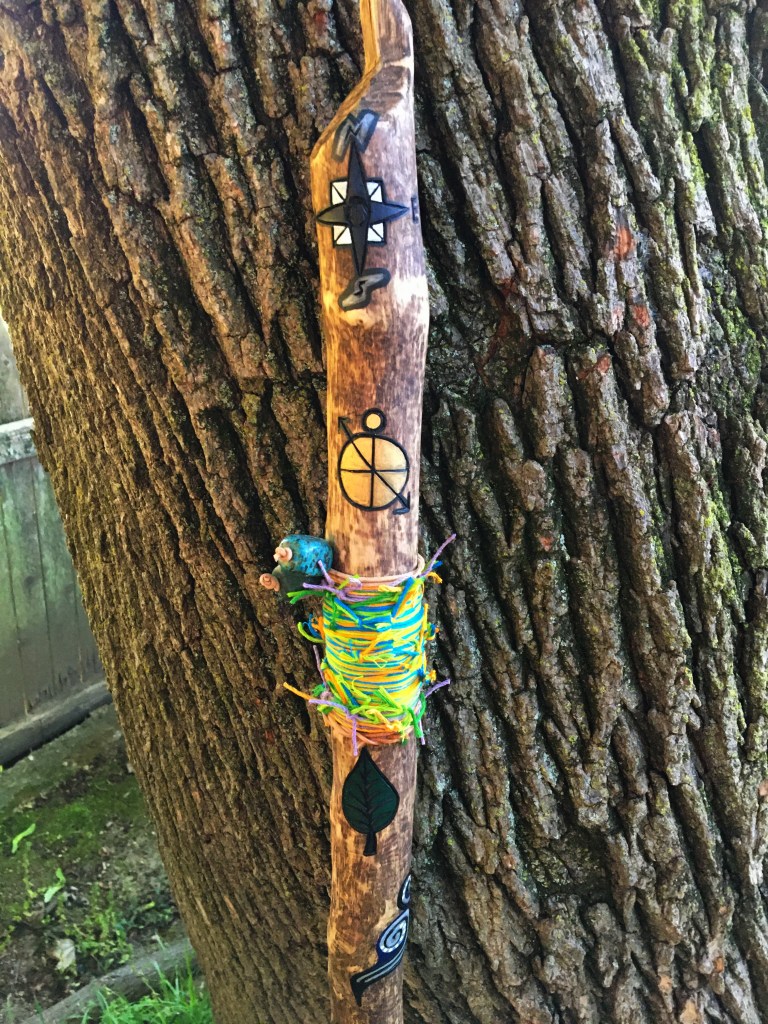
This is a shorter staff, perhaps more accurately a cane, and is made from a piece of beaver chew wood that’s 47.5” long, or just a half inch under 4 feet. The tips were shaped by beavers and their tooth marks can still be seen along its length. The top features a compass star above an astrolabe to symbolize guidance and direction. Below those are two turquoise beads threaded with rawhide and accented by vibrant strands of colored yarn symbolizing the intertwining of the four elemental forces: blue for water; green for earth; orange for fire, and light purple for air. Further down are a leaf, gusts of wind, a rain drop, and a flame, which are also meant to be representations of the four elemental forces. Opposite the compass star and astrolabe are a sun and crescent moon. Underneath those are a circle containing a river and pyramid and below that a star, the four symbolize the Sun, Moon, Earth and stars. The images are all wood burned then colored with paint pens. Acrylic sealer was used to keep the paint from smudging and to protect the wood from weathering as well as boiled linseed oil for the same purpose.
The blade and haft are a single piece of river wood and, as evidenced by the teeth marks and pointed tips, debark by beavers. I then used different colored yarn for the patterns. The black, red, yellow, and white bands were inspired by the medicine wheel found in numerous native North American cultures with each color representing one of the four the cardinal directions. Each band is bordered by smaller blue bands I intended to represent rivers, lakes, the seas and the overall importance of water. Below those is a crosshatch pattern of dark and light green, blue, and orange on a background of white meant to symbolize the interplay between earth, water, fire, and air. The blade is coated with boiled linseed oil and comes to just under 24” in length. A strand of pyrite, turquoise, and skull beads capped with found blue jay feathers is attached to the midpoint of the wand. The patterns on the haft have also been given a thin layer of acrylic sealer for some protection against weathering.
The wood of this wand is most likely birch, but was difficult to be certain because it’s also a “beaver chew,” also called a “beaver stick,” and has had the bark chewed off. But this process has left clear tooth marks on parts of the wand’s blade. The point of the wand was also created naturally by beavers.
Continuing with the strong natural theme of this wand I attached a quartz crystal to the bottom of the haft and used vines to help keep it secure. I also attached feathers I found, one from a blue jay, a cardinal, and a small yellow bird -probably some kind of finch. There’s a little detailing done with a wood-burner and bands of yellow, blue, and red hemp to match the colors of each feather.
It’s about 13.5” long and polished with boiled linseed oil.
















 Astrolabe Arts